
It was June 1914 when the heir to the Austrian throne, Archduke Franz Ferdinand, took a special train to Sarajevo. He was travelling with his wife Sophie. Little did he know that this train ride would lead to a chain of disasters that would lead to World War I.
In this article, we’ll explore this chain of events.
Table of Contents
Who was Archduke Franz Ferdinand?
Archduke Franz Ferdinand belonged to one of the most prestigious royal dynasties of Europe, the Habsburgs. The Habsburgs’ reign over Austria spanned over 900 years.
At the time of his birth, the archduke was not expected to inherit the Austrian throne. He was sickly and suffered from Tuberculosis. It was clear that no one expected him to do much when he came of age.
This feeling was so apparent that Franz felt he had to prove everyone wrong. He knew that if he had to make his mark, he needed to win over Emperor Franz Joseph, who was his uncle. This was easier said than done, as Franz Joseph was a workaholic. There are stories of him getting up at the crack of dawn every day and beginning work after a light breakfast. He wanted to do everything possible to ensure that the land was ruled by Monarchy and that his family held that power.
But as Franz Joseph worked tirelessly to keep his power, his family life was crumbling around him. His brother, Maximilian, was executed in Mexico. His wife, Empress Elizabeth, felt so suffocated by her life that she left him to travel through Europe. She was later killed by an anarchist. His only son, Rudolph, and his mistress committed suicide together.
This is how Franz Ferdinand came to become the heir of the Austrian throne. However, he had fallen in love and married a ‘common woman’, Sophie Chotek. This was troubling as, at the time, royals couldn’t just marry for love. The marriages had to be political arrangements. It was believed that if future kings and queens started marrying commoners, their bloodline would be diluted. Also, it was such a waste, as the marriage didn’t bring status or alliance. The whole reason that the empire of Austria-Hungary had reached this size was, in part, due to ‘correct’ marriages made by the previous generations.
Obviously, the Emperor hated the idea of the future heir marrying a common woman. But since Franz Ferdinand was set on marrying Sophie, the emperor laid a set of conditions on the marriage. None of his children would inherit the throne. Sophie would not be given respect as was becoming to the wife of an archduke. Her place in court would be at the end of the line, after the youngest and the least important people of the court.
The only relief that Sophie had was that she was treated like this only in the court of Vienna. When she travelled with her husband, she received all of the royal treatment that was due to her. Which is why they travelled as much as possible. And also why she was in the special train that day in June 1914. The only relief that Sophie had was that she was treated like this only in the court of Vienna. When she travelled with her husband, she received all of the royal treatment that was due to her. Which is why they travelled as much as possible. And also why she was in the special train that day in June 1914.
Who were Franz Ferdinand’s Assasins and What were their Motives?
Siberia, Austria’s southern neighbour, was keen to expand its kingdom and was trying to claim any place where its people, the Serbs, lived as their own. As Austria was Siberia’s next-door neighbour, many Serbs lived there.
At this time, some rebels felt that the Government’s efforts to get this land under their control were ‘too slow ‘, and they decided to take things into their own hands. They joined hands with an older secret terrorist group and called themselves ‘The Black Hand’ and ‘Ujedinjenje ili Smrt‘, which translated to English meant Union or Death. They took over an older group, Narodna Odbrana, known for developing anti-Austrian propaganda materials, and they were involved in various political murders, espionage, and sabotage.
When the group came to know that Franz Ferdinand was travelling to Serbia that June, the plan to assassinate him was set in motion. They trained three young men for the mission: Gavrilo Princip, Nedjelko Cabrinovic and Trifko Grabez.
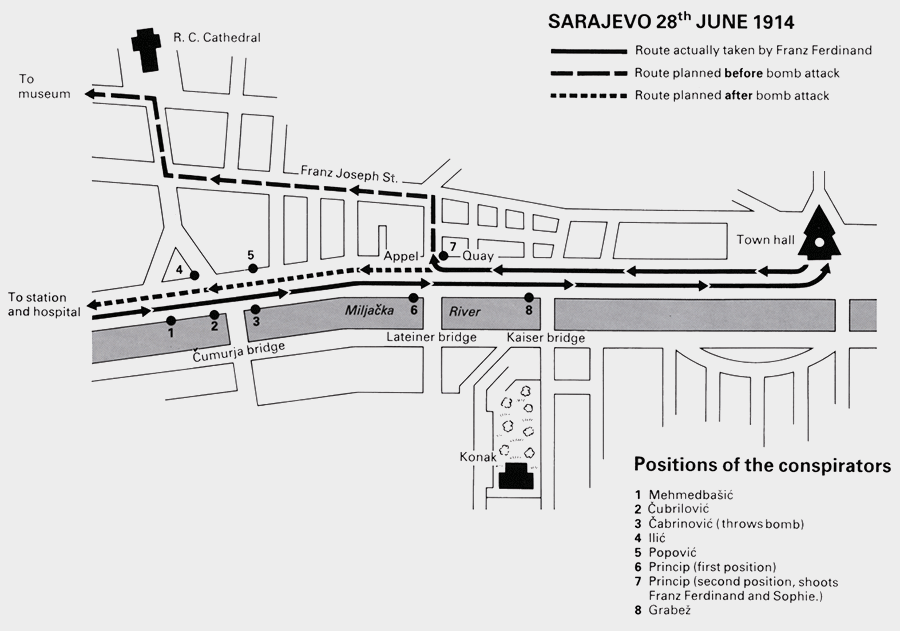
The image below shows a detailed plan of how the assassination and the escape route were planned and successfully executed.
The Aftermath and the Start of World War One
Some Serbian press celebrated the news of this assassination. Germany assured Austria that if they had to declare war against Serbia, they would support them. Thus assured of support, Austria came up with a list of demands to the Serbian Government on 23rd July. These demands were mostly to demand a trial for the assassins and to ensure the anti-Austrian elements and propaganda were suppressed. They were given two days to respond.
Siberia felt insulted by the demands and approached Russia for support. After securing Russia’s support, Siberia responded to Austria’s response. The response was half-hearted, with weak assurances of trial and outright denial of some of the other requests.
And so, on July 28, Austria declared war on Serbia and started World War One.